A longing to visit the island of Kauai has been churning inside of me for quite some time. Just last week I was able to visit it for two days with my wife. This is the second time being on this island and that first trip was also just a couple of days as well. Kind of yeah huh, on my first trip I was kind of in a rush and went all over the place and then just made dinner for ourselves in the hotel.
This time I was a little more conscious and actually tried to relax a bit and slow down from Honolulu time. If someone else in the world could relate to that. The outer island are in fact comparably more "chill" than that of Oahu. No freeways or TheBus to zoom around in and the speed limit was marked a little slower than simular roads on Oahu. There are multiple one-lane bridges that you need to stop and wait for opposite traffic to pass safely. What was cool was that everyone still left gaps in between cars while driving the speed limit. No faster, no slower besides confused tourists. Everything was much to my liking of true island lifestyle.
The first direction we headed once we got the rental car (sorry, no cycling on this trip. Maybe I'll come back for Pedal to the Meadow one year) was northeast to the end of the Kuhio Hwy. in Ha'ena. The first stop like my first trip had to be the caves, one dry and the other two wet caves. They are pretty touristy but not everyone is interested in entering them to have a look around. Most will simply observe from outside and then head off to Na'Pali or back the other way.
Maniniholo is the dry cave across Haena Beach park. It is said that there was a feast for the menehune when they finally left Hawaii from Kauai and boarded their canoes from the beach here. The menehune were a mysterious race of people living before the second wave of migrants to the island. Some say their last stronghold in Hawaii was on Kauai and near the NaPali area. They laborred in very large tasks such as fishing and building well designed rock structures such as temples and fishponds. They themselves were said to turn into stone if they were hit by the rays of the sun. That is why there are so many named pohaku on Kauai. On a more real note they may have been the Mu people.
Another race of mysterious origin is the 'e'epa people. In some stories they are similar to the menehune and even quarrel with the Mu race. In other stories they are superhuman or even deformed people. There is a legend that when the menehune left these shores. The 'e'epa people came out from the rocks in this cave and robbed the food for the feast of the menehune departure. They were caught and they were all killed in this cave.
Although if the Mu and 'E'epa are said to have made their last stand here and in the nearby district of Na Pali. Why is the Ahupua'a of Nu'alolo named after what may mean "brains heaped up?" Did they find refuge here and then migrate away to others islands in the Pacific due to mass genocide?

Waiokapala'e is the lower wet cave. Sometimes called Waiakapala'e. The colors of the water are related to the hair of a mo'o woman that lived there.

Waiakanaloa is the upper cave said to have been struck with Kanaloa's staff to reveal water. The lake within the cave is called Halaaniani. Only the Ali'i were able to bath or even drink this water. There are clear marked signs that this place is sacred and to be respectful. Although there are also signs that warn against swimming because of leptospirosis...

Finally after walking a few yards from our parking spot because it was very crowded. We made it to where I really wanted to see...
Lohiau's house site! This site sits just to the left of the beginning of the Na Pali Coast Trail. You will see this straight wall protruding from the overgrowth under the cliff. Lohiau is well known as Pele's lover that Hi'iaka eventually fell in love with and through many trial and tribulations they were eternally united. Lohiau was the high cheif of Kauai before that and he was very handsome and wise. He along with his court of family and close friends were able to trick the greedy Piliwale sisters and turn them into stone with the sunrise up on the cliff. Although two mo'o women Kalanamainu'u and Kilioekapua would claim his soul until it was restored to life by Hiiaka and then he was restored again by Pele's family after they returned to face Pele in Kilauea.


Next we checked the maps on the trail head to see if it led to the heiau near the shore. It did not so we walked along the shore on rocks and came to an abandoned house and then the greenery opened up to a large rock wall that I knew had to be the heiau I was looking for...

The northeast corner of the lower level wall on the makai side.


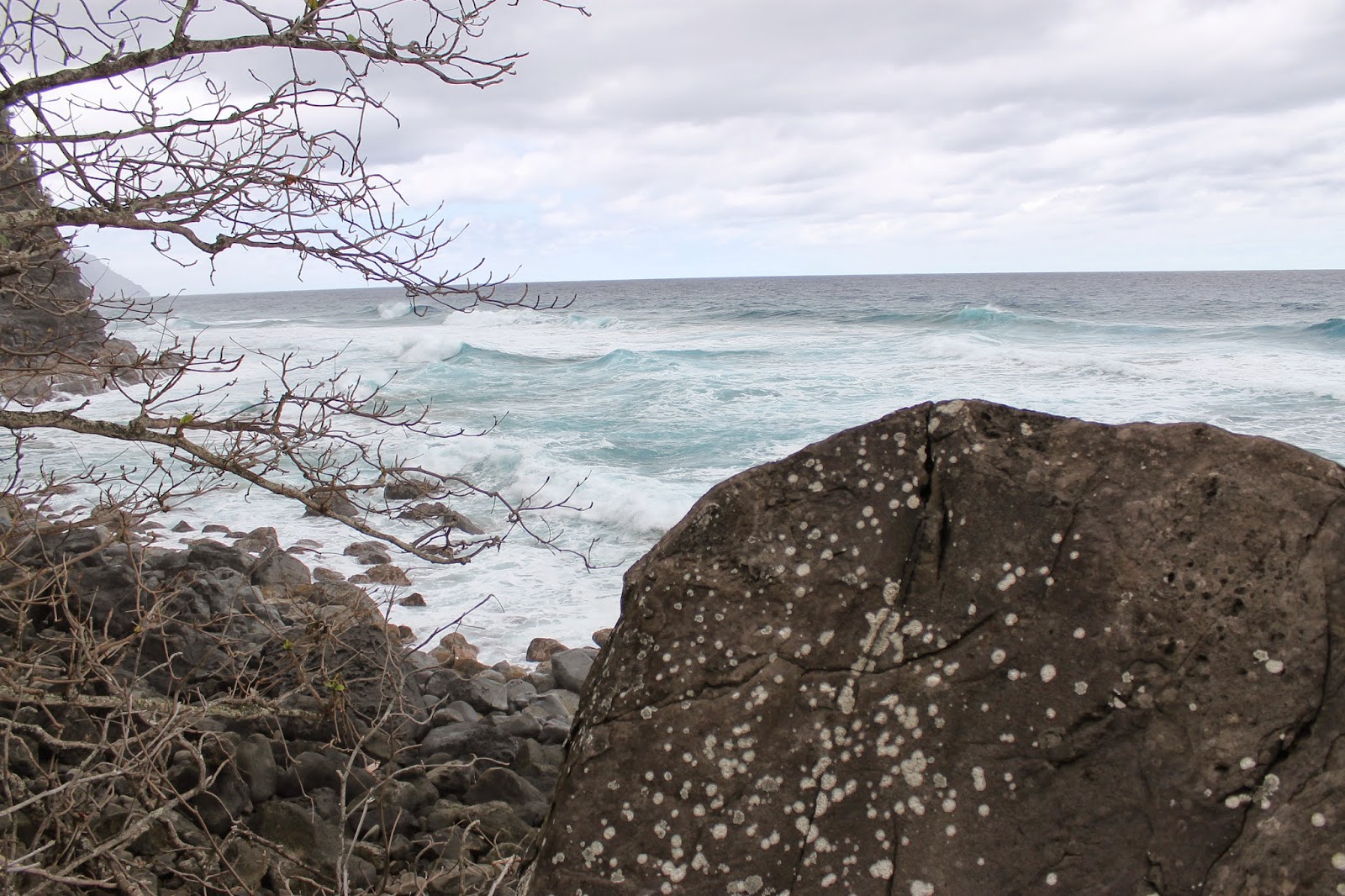
Just where the plants start growing and the ocean mist dampened stones on the beach boarder. There was a super large pohaku. It even looked connected to the northwest corner of the lowest makai wall because of a little rock wall that led to it. I thought it might be important so I was compelled to take pictures of all sides of it. Later on I read that this pohaku is named Kilioe. Yes the same Kilioe as in Kilioekapua. That took Lohiau's body and soul to a cave after his death. Kilioe was used to place a newborn's umbilical cord in in order that the child be protected by it. What would become of the ambilical cord would tell the fortunes of that child life...


The flat, well worn top of this large stone is about 15' high and maybe 9' wide. A fall from it would definitely break you on the stones below. It offered a magnificent view of the ocean and the heiau above.

Under it was a somewhat cave or at least a wind break with what looked like charring on the stones below and the ceiling.


Here is a better image to show the size of Kilioe in comparison to the hala grove and cliffs surrounding it. As observed from closer to the shore.


Just around Kilioe is a small sandy bay. This area is called Nahiki. It means many arrivals, and maybe because students of the heiau were challenged to swim from the sandy beach at Ke'e Lagoon and then out into the ocean and back into this area at Nahiki. Only some would make it back and others would drown of be eaten by a shark that was said to live in a cave off shore. That way the Mano, one of the major deities of Kauai were fed. It is said that those without fault were saved and those that broke the rules of training were eaten...


Ka Ulu O' Paoa was the school for history and genealogy. A very important faucet of life for any person living in the old times. Paoa was a hula master and a friend of Lohiau.


Now the inside of the heiau is covered in overgrowth. It was said to have been paved with flat stones and an oracle tower, wooden images, thatched house, and refuse pit were withing the walls during it's use.


Above that is Ka Ulu O' Laka, the school for hula. Also a very important aspect in the life of the ancients all of the way to present day. Although hula did go into hiding for a sometime during the time of the first missionaries whom shunned it as a dark practice.


The growth cleared to flat grass that looked maintained by someone or some group...


There was a 100ft. halau pavilion here with a thatched roof where ancient hula was practiced. It was also a shrine for Laka the patron goddess of Hula. Lehua, maile, palapalai fern, 'ie'ie vine, lama, ginger, 'akolea, laua'e fern, pili grass, koa branches, ulu, and kukui were the offerings carefully collected from the forest. Each having a special meaning. "The breadfruit signified growth. Pili means to cling, and so the grass signified the wish of the studentsto have the wisdom of the hula cling to them all the days of their lives." -There Were People Called Menehune


There was a small trail leading to a fresh water source in the form of a small waterfall that fell down a small valley and met the sea at Nahiki Bay.


Back at the very top of the heiau structure was most likely Lohiau's shrine.
"The rules during the time of training were very strict. A pupil could only share his or her food with other members of his class. Certain foods were kapu, such as sugar cane, taro tops, certain types of seaweed, and squid. If such foods were eaten the knowledge of the hula would flee from the student. Sexual intercourse was prohibited during the time of training. Fingernails could not be cut, nor hair trimmed, and men could not shave. Yet each day the pupils had to bath and change their clothes. From the days of the building of the altar until graduation, the greenery remained fresh because Laka was there. After the graduation ceremony, the leaves and blossoms became brown and fell away."


~more next week, Aloha!


